

How rising fuel costs are accelerating the shift to electric vehicles and home solar, and what it means for energy independence.
Rising fuel prices are reshaping how New Zealand households think about transport and energy. With petrol now sitting around $3.24 a litre and some Auckland stations exceeding $4, the average Kiwi family is spending close to $147 a week on fuel – up from roughly $114 in February.
That change is influencing buying choices – new EV registrations in New Zealand are up 128.8% year-on-year, with EV market share more than doubling from 5.7% in 2025 to 10.7% so far in 2026. Home solar is being reframed from an environmental upgrade to a practical hedge against rising costs. And research released in April 2026 shows that about 90% of New Zealand households are now feeling the impact of the fuel situation in some form.
This article looks at the data behind the shift, the cost difference between petrol, grid power and solar, and why pairing an EV with home solar is emerging as a measured response to ongoing energy market volatility.
Why the Fuel Pressure Isn’t Easing
New Zealand imports 100% of its refined fuel, mostly from Singapore, South Korea and Japan. When global oil markets move, as they have following disruption to the Strait of Hormuz, the effect reaches local pumps within weeks. Average petrol prices in New Zealand are currently around 40% higher than pre-conflict levels, and diesel has risen by approximately 94%.
Though there is no fuel shortage in New Zealand ( MBIE has confirmed that supply is operating normally, with stocks well above minimum requirements), the challenge is on price, and current cover sits at roughly 51 days for petrol and 41 days for diesel, a limited buffer for a country that is dependent on imports.
Sentiment data reflects how this is landing with households. 59% of New Zealanders now cite cost of living as their top concern, with fuel shortages and pricing the second-most-cited concern at 20%. 67% are reducing discretionary spending, and 66% are cutting back on travel – both up sharply over the past two weeks.
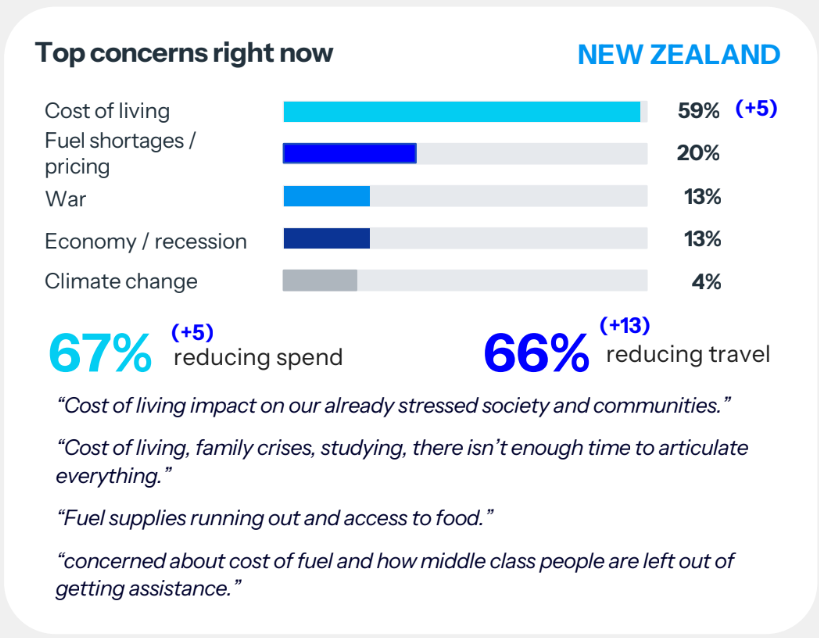
Omnicom Intelligence, Pulse 03 – top concerns, behaviour change tracking, fieldwork April 2026.
The EV Shift Is Already Underway
Buyer behaviour has changed quickly. According to NZTA registration data reported by 1News, electric and plug-in hybrid vehicles rose to 1033 in March, compared to 225 last year. Industry reports also indicate EV stock is being purchased before vehicles arrive in the country, with several distributors noting tightening inventory and growing waiting lists.
Consumer research supports the trend. Interest in purchasing a hybrid or EV nearly doubled in New Zealand to 9% in the most recent April 2026 wave – a notable jump given that EVs typically sit much further down the consideration funnel than everyday purchases.
The driver behind the shift is largely economic. Based on a household driving around 10,100 km per year, in line with the average for a New Zealand hatchback, running a petrol car at 7.5 L/100km and current pump prices works out to roughly $2,485 a year in fuel. The same distance in an EV charged from the grid costs approximately $654 before road user charges – about a quarter as much.
The Real Cost: Petrol vs Grid vs Solar
Savings at a glance Excluding RUC
| Fuel Source | Cost Per Unit | Annual Cost | Savings Vs Petrol |
| Petrol Car | $3.28/L (at 7.5L/100km) | $2,485 | __ |
| EV Charged from grid | Avg. residential power rate | $654 | $1,831 |
| EV charged from Solar | Self-generated solar | $98 | $2,387 |
Savings at a glance Including RUC
| Fuel Source | Cost Per Unit | Annual Cost | Savings Vs Petrol |
| Petrol Car | $3.28/L (at 7.5L/100km) | $2,485 | — |
| EV Charged from grid | Avg. residential power rate + RUC | $1,422 | $1,063 |
| EV charged from Solar | Self-generated solar + RUC | $866 | $1,619 |
Assumptions for these calculations:RUC is based on 2027 charges ($768). Petrol consumption based on 7.5 litres/100km. EV power consumption is based on the evbd.nz database of WLTP consumption ratings for all EVs. Petrol costs based on $3.28/litre (Gaspy.nz, Unleaded 91, 08.05.26). RUC, Petrol and EV power consumption is based on 10,100 km of travel per year (carjam.co.nz, hatchback avg).
Switching from petrol to a grid-charged EV already saves an average household around $1,800 a year. However, grid power costs are also rising. New Zealand’s average residential electricity price now sits at 39.3 cents per kWh, having climbed 21% over the past three years. A further 5% increase is forecast for 2026, with line charges scheduled to keep rising through to 2030.
In practical terms, an EV addresses the petrol cost. But charging from the grid alone still leaves households exposed to ongoing electricity price increases. Once you have solar installed, the energy used to charge your EV is almost free – turning sunlight directly into kilometres driven. Pairing an EV with home solar is what addresses both pressures – and it explains why solar is increasingly being positioned as a resilience investment rather than a sustainability upgrade.
Beyond Cost: Energy Independence
Cost savings are only part of the picture. Petrol prices are determined by global events well outside any household’s control. Grid electricity prices are shaped by lines companies, wholesale market dynamics and infrastructure investment cycles. Solar generation, by contrast, is one of the few components of household energy spending that homeowners can directly influence.
Once a solar system is installed, the underlying cost of generating that electricity remains stable. It is unaffected by international conflict, line charge increases or wholesale market volatility. With a typical system designed for 25 years of generation, the cost of self-produced power is locked in for decades.
This shift is visible in the broader sentiment data. 44% of New Zealand households now say their income only covers the essentials, up six points in two weeks. The dominant response is not to abandon major decisions but to delay them – 33% of New Zealanders report delaying big purchases, up seven points. For investments that demonstrably reduce ongoing costs, this represents postponement rather than rejection.
Against that backdrop of rising costs, solar stands out as one of the few areas where a household can take direct control rather than simply absorbing the increases. When solar is paired with an EV, the combined effect is significant. The household’s largest energy expense – daily transport – moves from a volatile, externally-priced fuel source to one that is predictable, on-site and largely insulated from market shocks.
What This Looks Like for a New Zealand Household
The right configuration depends on lifestyle and driving patterns. Three common scenarios illustrate the range of outcomes:
The commuter family. Two cars covering around 30,000 km combined per year. Switching one vehicle to an EV charged from solar can reduce the household’s annual energy and fuel costs by more than $5,000. Because most charging takes place overnight, a home battery delivers significant additional value in this scenario.
The retiree couple. One vehicle, used primarily during the day, with the home occupied during peak sunlight hours. This profile is well-suited to solar-charged EVs, as the vehicle is typically plugged in when generation is at its highest.
Hybrid or remote workers. Someone splitting their week between a home office and on-site visits, or working from home most days with the EV parked in the driveway. The vehicle sits at home through the middle of the day (right when solar generation peaks) so charging windows line up naturally with free energy from the roof.
In each scenario, the recommended configuration combines home solar generation with a home EV charger designed to draw directly from solar, and — for households seeking greater resilience – a home battery to store daytime generation for overnight use. For homes with limited roof space, a SolarPort carport offers an alternative, generating power directly above the parked vehicle.
Common Questions Asked
- Is it cheaper to charge an EV from solar than the grid?
The fairest way to compare solar against grid power is to spread the system’s upfront cost across all the energy it will generate over its lifetime. For example, a $10,000 solar system that produces roughly 150,000 kWh across its lifespan works out to about 6.7c per kWh. Compare that to current grid power, which sits at around 30–40c per kWh nationally, and solar comes in at a fraction of the cost, even before the system is paid off.
- Can an EV be charged during the day if no one is home?
Yes. Most modern EV chargers can be scheduled to switch on during peak solar hours, so the car charges straight from the panels even if no one is home.
- Is a battery required to make solar worthwhile with an EV?
The real value of a home battery isn’t in shortening your payback period, it’s in the flexibility and resilience it adds to your setup. A battery lets you charge your EV from stored solar power even when the grid is down, and it’s a good fit for households whose schedules don’t line up with peak solar generation, for example, if the car is rarely home during the middle of the day. Without a battery, you’ll either need to charge during daylight hours or export excess solar to the grid at the buyback rate, which is typically lower than what you pay for power.
- How long does a solar plus EV setup take to pay back?
Payback periods vary based on system size, household consumption and annual driving distance. Higher petrol and grid power prices both shorten the payback timeframe.
A Practical Response to an Unpredictable Market
Petrol prices may settle, or they may remain elevated for some time. Grid power costs are forecast to keep climbing through to 2030. Within that uncertainty, the cost of solar generation is one of the few variables a homeowner can fix.
That predictability is why a growing number of New Zealand households are pairing EVs with home solar – not as an environmental statement, but as a deliberate strategy to reduce exposure to volatile fuel and energy markets. An EV addresses the petrol cost. Solar addresses the grid power cost. Together, they offer something increasingly difficult to find in the current energy market: certainty.
For households considering an EV, or already running one, a tailored assessment is the most useful next step. Explore Lightforce’s solar and EV charging packages to understand what charging from your own roof would look like for your home and driving pattern.